A bunion, also called hallux valgus, develops when the bones around the big toe joint move out of alignment, causing the big toe to angle toward the smaller toes.
This can lead to pain, swelling, joint stiffness, difficulty wearing shoes, and changes in the way you walk. Not every bunion needs surgery. The decision is generally based on pain and loss of function—not simply the appearance or size of the bump.
A surgical assessment may be appropriate when:
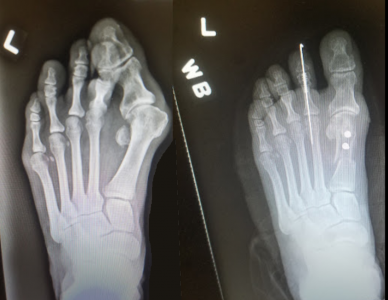
There is no single bunion surgery that is right for every patient. The recommended procedure depends on the location and severity of the deformity, the condition and mobility of the joint, stability, bone quality, general health, activity level, and recovery goals.
Bunion surgery usually aims to relieve pain, improve alignment, and create a more functional foot. In many procedures, the bones are realigned rather than simply shaving down the visible bump.
Depending on your assessment, surgical options may include one or a combination of the following approaches.
An osteotomy involves making a controlled cut in one or more bones so they can be moved into better alignment. The corrected position is commonly held with screws, plates, pins, or other fixation while the bone heals.
Different osteotomy techniques can be used at different locations in the first metatarsal or big toe. The choice is based on the specific pattern and severity of the bunion rather than one procedure being best for everyone.
A Lapidus procedure corrects the bunion through the first tarsometatarsal joint in the midfoot. The joint is realigned and fused using surgical fixation. It may be considered when the deformity involves instability or abnormal alignment at this joint, in some severe bunions, or in certain recurrent cases.
Because a fusion must heal, the post-operative protection and weight-bearing plan may differ from that used for an osteotomy.
Fusion of the first metatarsophalangeal joint—the joint at the base of the big toe—is a different procedure from the Lapidus operation. It may be considered when severe arthritis, joint damage, a very stiff deformity, or a previous unsuccessful operation makes joint-preserving surgery less suitable.
The goal is to relieve pain and create a stable position. The fused joint no longer bends after it has healed.
Some bunions can be corrected through several small incisions using minimally invasive instruments and X-ray guidance during surgery. Other deformities are better treated through an open approach that gives the surgeon direct access to the bones, joint, and surrounding soft tissues.
Smaller incisions may offer early recovery advantages for appropriately selected patients, but minimally invasive surgery is not automatically the best or fastest option for every bunion.
Your surgeon will review the recommended procedure, expected benefits, possible risks, recovery requirements, and alternatives. Pre-operative testing or medical clearance may be needed depending on your health and the planned surgery.
This is also the time to plan for time away from work, help at home, transportation, and any mobility aid you may need during recovery.
Most bunion operations are outpatient procedures, which means patients generally return home the same day. Surgery may take place in a hospital or an appropriate surgical facility.
The type of anaesthesia and the length of the operation depend on the procedure and the patient’s medical needs. Some procedures involve bone cuts and surgical fixation, while others involve a joint fusion or additional soft-tissue correction.
You will receive specific discharge and post-operative instructions from your surgical team.
Your recovery plan will depend on the procedure performed and the stability of the correction. Some patients may be allowed to walk in a protective post-operative shoe soon after surgery. Other procedures require a period of limited or no weight-bearing while the bone or fusion heals.
Crutches, a walker, or a knee scooter may be recommended. Do not change your weight-bearing level, footwear, dressing, or activity restrictions until your surgeon advises that it is safe.
Feldman & Leavitt Foot & Ankle Specialists brings together decades of experience in corrective foot and ankle care. The clinic’s surgical expertise is supported by Dr. Ziv Feldman’s more than 25 years of practice in the Calgary region and Dr. Darren Leavitt’s advanced residency training in forefoot, rearfoot, and ankle surgery.
Every recommendation begins with an individual assessment, with surgery considered only when appropriate for the patient’s diagnosis, symptoms, health, and goals.
Recovery varies considerably between patients and procedures. A realistic plan is more useful than a fixed promise.
In general:
Initial bone healing often takes several weeks, but full recovery commonly takes several months. Swelling may remain for six months or longer, and it can take time to fit comfortably into regular footwear.
Your surgeon will provide a recovery plan based on your procedure and healing progress.
The goal of bunion surgery is to reduce pain and improve function by correcting the deformity. Many patients experience meaningful improvement, but no surgical result can be guaranteed.
Possible risks and complications include:
Smoking, diabetes, poor circulation, certain medications, and other health conditions can affect healing. Your surgeon will review your individual risk factors before surgery.
The cost of bunion surgery in Calgary depends on whether treatment is provided through an Alberta Health Services-contracted route or as private surgery, as well as the procedure, facility, anaesthesia, and any non-insured services.
According to the Government of Alberta, eligible services provided by a podiatric surgeon in an Alberta hospital or non-hospital surgical facility under contract with Alberta Health Services are fully covered. A physician referral is required to access this contracted surgical route.
Private surgery may also be available. Fees and insurance reimbursement vary, so the clinic should provide an individualized estimate before treatment. Patients should also confirm coverage for consultations, private surgical services, post-operative devices, physiotherapy, and orthotics with their insurer.
Non-surgical treatment cannot permanently move the bones back into normal alignment, but it may reduce pain and pressure. Options can include wider footwear, activity modification, padding, medication when appropriate, and orthotics for selected patients.
If these treatments keep symptoms manageable, surgery may not be necessary.
Surgery is not normally recommended only because a bunion is visible or appears to be getting larger. The decision is usually based on pain, function, examination findings, imaging, general health, and whether non-surgical treatment has been adequate.
Not for every patient. Minimally invasive techniques use smaller incisions and may offer some early recovery benefits, but suitability depends on the deformity, bone quality, associated conditions, and the correction required. Research comparing minimally invasive and open surgery has not shown one approach to be superior in every situation.
That depends on the procedure. Some patients can bear protected weight soon after surgery, while others must avoid or limit weight-bearing for several weeks. Your surgeon will explain the plan before the operation.
There is no single return-to-work date. A patient with seated work and the ability to elevate the foot may return sooner than someone whose job requires prolonged standing, walking, lifting, or safety footwear. Your surgeon will give guidance based on the procedure and your job.
Yes. Recurrence is possible after any bunion procedure, and published rates vary because studies use different procedures, follow-up periods, and definitions of recurrence. Careful procedure selection, adequate correction, bone healing, and following post-operative instructions all affect the long-term result.
Alberta provides full coverage for eligible services delivered by a podiatric surgeon in a hospital or non-hospital surgical facility under contract with Alberta Health Services. A physician referral is required for that route. Private surgery and non-insured services may involve patient fees. Contact the clinic for the options that apply to your case.
Most bunion procedures are completed on an outpatient basis. Patients generally go home after post-anaesthesia monitoring and need a responsible adult to provide transportation and help follow the early recovery instructions.

Feldman & Leavitt Foot & Ankle Specialists provides bunion assessments and surgical consultations for patients from across Calgary and nearby communities, including Airdrie, Cochrane, Chestermere and Okotoks.
Patients travel to the clinic for individualized evaluation, treatment planning and follow-up care.

The right treatment begins with an individual assessment. Meet with Feldman & Leavitt to discuss your symptoms, treatment options, and whether surgery may be appropriate for you.