
What Is a Bunion? Symptoms, Causes, and When It’s Not “Just a Bump”
A bunion is more than a cosmetic concern—it’s a progressive deformity of the big toe joint that can significantly impact how you walk, what shoes you can wear, and your overall quality of life. Understanding what’s actually happening inside your foot helps you make informed decisions about treatment before the condition worsens.
What Is a Bunion?
A bunion, medically termed Hallux Abductovalgus, is a structural deformity at the joint at the base of the big toe where it connects to the first metatarsal bone. This condition causes a visible bump on the inside of the foot as the big toe angles toward the second toe while the associated metatarsal bone shifts in the opposite direction.
Bunions develop slowly over months to years and affect up to 23% of adults aged 18-65. Women over 40 experience them at significantly higher rates 35-50% in those over 65 due to ligament laxity and footwear patterns. However, bunions can appear earlier, including juvenile forms in girls aged 10-15 with hypermobile foot structures.
This is not simply extra bone growth or thickened skin from friction. A bunion reflects genuine joint misalignment that typically progresses without intervention. A tailor’s bunion (bunionette) affects the little toe on the opposite side of the foot, but the primary focus here is the more common big toe bunion.
Key facts:
- Medical name: hallux abductovalgus deformity
- Location: first metatarsophalangeal (MTP) joint
- The bony bump is the exposed metatarsal head, not new bone
- Bilateral involvement occurs in up to 70% of cases
- Genetic predisposition plays a larger role than footwear alone
Image: What a Bunion Looks Like

The bump appears at the MTP joint where the big toe meets the foot. In a normal foot, the toes align parallel. With a bunion, the big toe drifts toward the other toes while the metatarsal head protrudes medially.
Bunion Symptoms: When a Bump Starts to Hurt
Most bunions begin as a painless bump that gradually becomes problematic. As the deformity progresses, inflammation develops from repetitive pressure, and the overlying skin becomes irritated—particularly when you wear shoes with a narrow toe box.
Early symptoms:
- Firm, palpable bump at the base of the big toe
- Redness and swelling over the toe joint
- Pain when wearing narrow shoes or high heels
- Toes rub against footwear
Advanced symptoms:
- Chronic pain or burning at the first MTP joint
- Limited movement and stiffness in the big toe
- Difficulty walking distances beyond 1-2 kilometers
- Trouble walking at the end of long days
Secondary complications:
- Corns or calluses between the first and second toe
- Hammertoe deformities in smaller toes
- Pain under the ball of the foot, especially under the second MTP (metatarsalgia)
Symptoms typically worsen after prolonged standing, walking, or wearing high heeled shoes. Bilateral involvement, night pain, or rapid worsening should prompt earlier evaluation.
What Causes Bunions?
Bunions result from inherited abnormal foot structure combined with external stressors that destabilize the big toe joint. Twin studies indicate heritability of 45-69%, making genetics the primary factor rather than footwear alone.
Structural risk factors:
- Flat feet (20-30% more common in bunion patients)
- Loose ligaments and hypermobility
- Long first metatarsal bone
- Low longitudinal arch
External triggers:
- Wearing narrow, pointed shoes regularly
- High heels over 4cm (increases forefoot pressure by 75%)
- Prolonged standing (>6 hours daily)
- Repetitive sports like ballet or running
Associated medical conditions:
- Rheumatoid arthritis (3-5x increased risk)
- Osteoarthritis
- Connective tissue disorders
Women develop bunions 2-10 times more frequently than men, partly due to hormonal effects on ligament laxity. However, footwear choices accelerate progression in those with susceptible foot mechanics. Also, women tend to seek medical care more often than men for their bunions.
Anatomy of a Bunion: What’s Happening in Your Big Toe Joint
The normal first MTP joint functions as a hinge between the first metatarsal bone head and the proximal phalanx. This joint bears 40-60% of forefoot weight during walking and allows 65-70 degrees of dorsiflexion.
In hallux valgus, the first metatarsal drifts inward while the big toe deviates outward from its normal position. The “bump” is the metatarsal head becoming exposed, often with an inflamed bursa (fluid-filled sac) on top.
The intermetatarsal angle (IM) measures the spread between the first and second metatarsals—normal is under 8 degrees. As these angles increase, weight distribution shifts laterally by 30-50%, affecting overall foot function.
Bunion Progression and Possible Complications
Without intervention, most bunions worsen gradually over 5-10 years. Early stages involve cosmetic changes with occasional discomfort; later stages bring constant pain and structural problems that complicate treatment.
Potential complications:
- Bursitis (inflammation in 50-70% of painful bunions)
- Hammertoe deformities in adjacent toes (30% of cases)
- Degenerative arthritis within the joint
- Forefoot widening requiring 1-2 shoe sizes larger
- Antalgic gait (limping) reducing stride length by 20%
Functional impacts:
- Limited walking distance (under 500 meters in severe cases)
- Inability to participate in normal activities
- Kinetic chain issues affecting knees, hips, or back
Adolescent bunions in girls aged 10-15 often maintain joint motion but create significant shoe-fit problems. Ignoring rapidly progressing deformity can reduce surgical success rates below 80%.
How Bunions Are Diagnosed
Diagnosis is straightforward, typically confirmed in a single visit through physical examination and X-rays. A podiatrist,can evaluate the condition.
Diagnostic process:
- Visual inspection for medial eminence and toe angulation
- Palpation for tenderness and bursitis
- Assessment of joint motion and digital deformities
- History of symptom onset, shoe wear, and functional limitations
- Standing (weightbearing) X-rays to measure angles
Advanced imaging like CT or MRI is reserved for atypical pain patterns or suspected complex arthritis, needed in only 5-10% of cases.
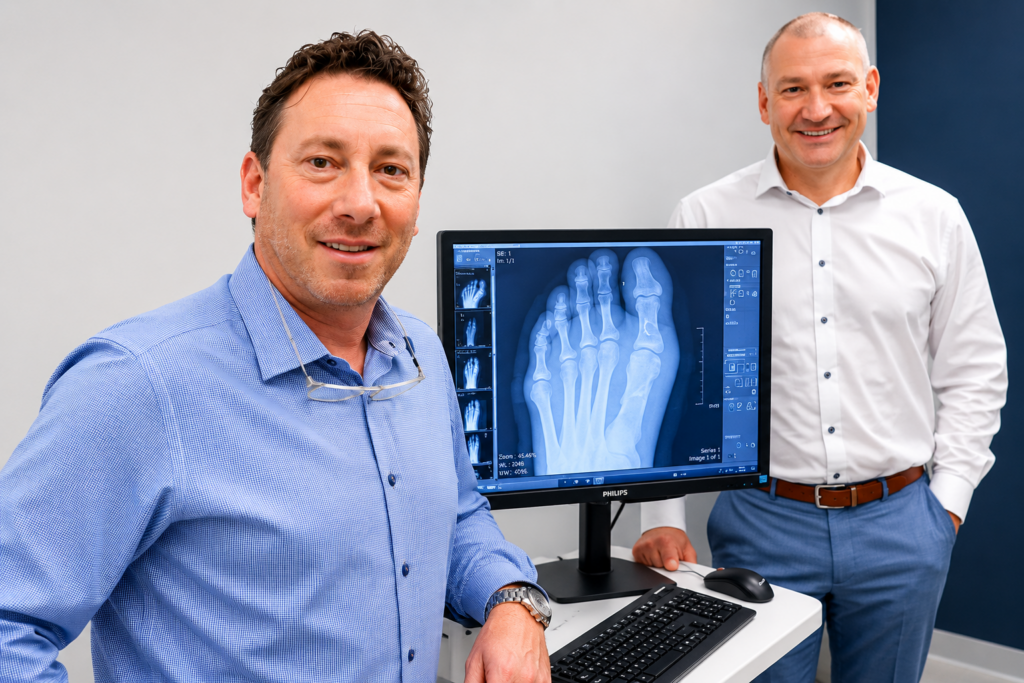
Image: Bunion X-Ray
Weightbearing X-rays reveal true deformity under load. Surgeons use these images to classify severity and plan treatment, particularly when bunion surgery is considered.
Non-Surgical Bunion Treatment: Relief and Slowing Progression
Conservative bunion treatment is the first-line approach, achieving 85% patient satisfaction at one year for pain and function. While these measures don’t reverse deformity, they can maintain comfort for years.
Footwear modifications:
- Choose shoes with deep toe boxes (width >100mm)
- Limit heels to under 3cm
- Avoid shoes with pointy toes
- Select soft uppers and rigid shanks
- Wearing well fitting shoes prevents flares
Padding and supports:
- Bunion pads (gel or silicone) reduce friction by 40%
- Toe spacers create 1-2mm gap between toes, but do not get rid of your bunion
- Shoe inserts or custom orthotics redistribute pressure and can slow down the progression of the bunion
Pain management:
- Ice application (15 minutes, twice daily)
- NSAIDs like ibuprofen (if medically appropriate)
- Topical anti-inflammatory gels
Activity modifications:
- Limit prolonged standing
- Choose low-impact exercise (swimming, cycling)
- Avoid shoes that provoke symptoms
Home Care: What You Can Do Yourself Right Now
Immediate actions to relieve pain:
- Switch to comfortable shoes with enough room for toes
- Apply pharmacy bunion pads over the bump
- Ice for 10-15 minutes after long days
Maintain mobility:
- Gentle big toe stretches (10 repetitions, 10-second holds)
- Calf wall stretches (3 repetitions, 30 seconds each)
- Range-of-motion exercises to preserve flexibility
What to avoid:
- Narrow shoes or pointed shoes
- High heels for extended periods
- Barefoot walking on hard surfaces
- Ignoring persistent swelling or skin breakdown
Over-the-counter pain relievers can help reduce pain, but consult a clinician if you have kidney disease, ulcers, or take blood thinners.
When Is It Not “Just a Bump”? Signs You Should See a Specialist
Many mild bunions are manageable at home. However, certain symptoms indicate the painful condition requires professional evaluation.
Schedule an appointment if you experience:
- Daily or nightly bunion pain rated >4/10
- Difficulty walking normal distances
- Giving up activities due to foot problems
- Failed conservative treatment after 3-6 months
- Pressure on the big toe causing skin breakdown
Seek urgent care for:
- Sudden severe redness and warmth (infection signs)
- Open sore or drainage over the bump
- Fever accompanying foot symptoms
- Rapid deformity change over weeks
People with diabetes, poor circulation, or neuropathy should seek evaluation earlier for any bunion-related skin changes due to 10x higher amputation risk.
Surgical Treatment: When Bunion Surgery Becomes the Best Option
Surgery becomes appropriate when painful bunions significantly affect daily life and conservative measures no longer provide relief. The goal is realigning bones and restoring function—not just removing the visible bump.
Common procedures:
- Osteotomy: cutting and repositioning bone to correct position
- Soft tissue balancing: adjusting ligaments and tendons
- Joint fusion: reserved for severe arthritis cases
Most operations are outpatient, with patients going home the same day. A surgical boot, special shoe, or crutches/knee scooter are typically needed for several weeks.
Recovery timeline:
- Initial healing: 6 weeks
- Return to regular shoes: 6-weeks
- Full activity: 3-6 months
- Swelling resolution: up to 12 months
Success rates reach 85-95% for pain relief, with 90% patient satisfaction. However, 10-15% recurrence risk exists, particularly without proper post-operative footwear. Surgery is not recommended solely for cosmetic reasons when the one foot has minimal pain.
Can You Prevent Bunions or Stop Them from Getting Worse?
Complete prevention isn’t possible when genetics play a major role. However, controllable risk factors can slow progression by 30-50%.
Prevention strategies:
- Choose well fitting shoes with wide toe boxes throughout life
- Limit high heel wear and avoid wearing narrow shoes regularly
- Use custom orthotics to help control pronation forces that can contribute to bunion progression
- Maintain healthy body weight (each 1kg excess adds 4kg forefoot force)
- Begin preventive habits in adolescence if family history exists
- Stay active with low-impact exercises
Per the American Podiatric Medical Association, proper footwear selection remains the most modifiable factor in managing bunion progression.
Bunion FAQs: Quick Answers to Common Questions
- Do bunions go away on their own? No. Only surgery corrects the deformity, though symptoms can be managed conservatively in 60-80% of mild-moderate cases.
- What’s the difference between a bunion and bunionette? A bunionette affects the pinky toe (fifth MTP joint) on the lateral foot. Both can be bunions treated with similar conservative approaches.
- Can a splint worn at night straighten my toe? Splints provide temporary relief (5-10 degrees correction) but recur when removed. They don’t offer permanent correction despite what social media ads claim.
- Is running safe with a bunion? Yes, with proper footwear and orthotics. Pain affects under 20% of runners with bunions.
. - Will my bunion return after surgery? Recurrence occurs in 10-20% of cases. Protective factors include proper footwear, weight management, and following your treatment plan.
- Do I need surgery if I have limited movement but no pain? Surgery is generally not recommended for the longest toe deformity without significant symptoms affecting normal activities.
Next Steps: Getting Personalized Help for Bunion Pain
You don’t have to live with daily bunion pain or give up activities you enjoy. The best approach depends on your bunion severity, symptoms, health history, and personal goals—whether that’s returning to sports, fitting into work shoes, or simply walking without discomfort.
Prepare for your consultation:
- Document symptom patterns and pain triggers
- List treatments you’ve already tried
- Note questions about recovery time and activity restrictions
- Consider your footwear needs and work demands
A podiatric foot and ankle specialist,or podiatrist, can evaluate your condition and develop a personalized plan. For those struggling with shoe fit, activity limitations, or considering surgery, professional evaluation optimizes outcomes—restoring function in 85-95% of cases.
Contact Form – Calgary Podiatry
Contact Form – Please let us know about your condition in the below box so our team can better assist you.