Many patients first notice progressive prominence at the base of the big toe, discomfort in certain shoes, or irritation after prolonged walking before realizing hallux valgus deformity may be developing. Bunions are among the most common forefoot conditions treated by podiatrists in Alberta and often progress gradually over many years.
This guide explains the early signs of bunions, how podiatrists assess the condition, what symptoms suggest progression, and when it may be appropriate to consult Dr. Kevin Dow, Dr. Ziv Feldman, or Dr. Darren Leavitt at Feldman & Leavitt Foot & Ankle Specialists in Calgary.
Initial Self-Assessment for Hallux Valgus
This at-home screening checklist may help identify common signs of bunion deformity but does not replace professional evaluation.
While standing barefoot, assess the following:
- Prominence at the base of the big toe on the inner side of the foot
- Progressive drifting of the big toe toward the second toe
- Redness, swelling, or thickened skin over the first metatarsophalangeal (MTP) joint
- Tenderness when pressure is applied to the joint
- Increased irritation in footwear that previously fit comfortably
- Difficulty fitting into narrower shoes, work boots, or winter footwear
- Visible asymmetry between the two feet
Patients experiencing several of these findings commonly demonstrate early hallux valgus deformity and may benefit from podiatric assessment.
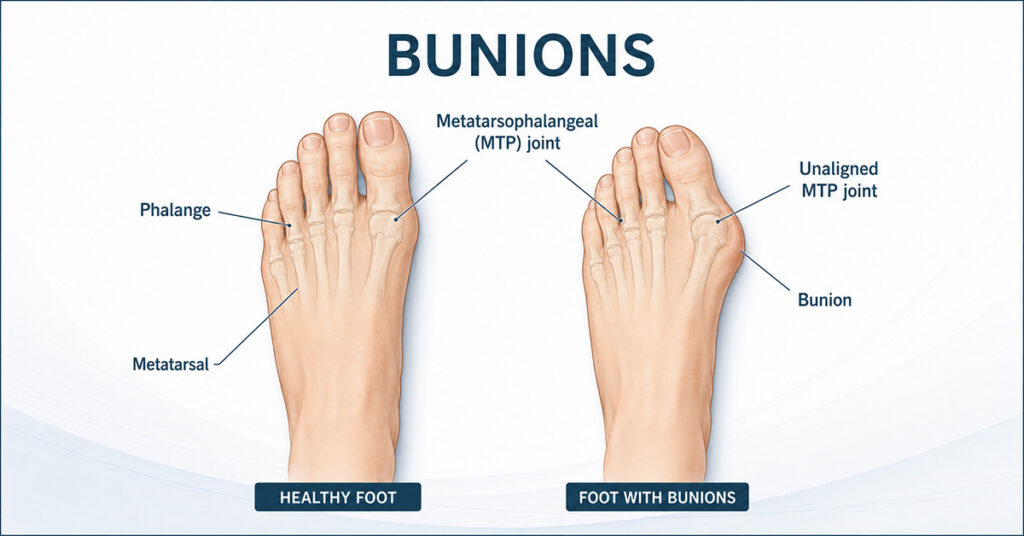
What Is a Bunion? (Hallux Valgus)
A bunion is a structural deformity involving progressive lateral deviation of the hallux relative to the first metatarsal, resulting in medial prominence at the first metatarsophalangeal joint. The condition is medically termed hallux valgus.
Contrary to common belief, a bunion is not simply “extra bone growth.” The deformity develops as the alignment of the forefoot progressively changes over time.
As the first metatarsal drifts medially and the hallux shifts laterally, abnormal joint loading develops across the forefoot. Joint capsule laxity, altered biomechanics, and sesamoid malposition may further contribute to progression.
A related condition called a bunionette, or tailor’s bunion, affects the fifth metatarsal head near the little toe.
Common Signs and Symptoms of Bunions
Symptoms vary significantly between patients and are often more closely related to joint irritation and functional limitation than the visible size of the deformity itself.
Common symptoms include:
- Pain or aching around the first MTP joint
- Redness and inflammation over the medial eminence
- Difficulty wearing certain footwear comfortably
- Progressive crowding of the lesser toes
- Stiffness during walking or push-off
- Callus formation from abnormal pressure distribution
- Burning discomfort after prolonged standing or activity
- Reduced walking tolerance
- Difficulty wearing occupational footwear such as steel-toe boots
Many Alberta patients first seek care after noticing progressive irritation during work activities, prolonged standing, or winter footwear use.
Early Symptoms Before Significant Deformity Appears
Early hallux valgus may present before a large visible prominence develops.
Patients commonly report:
- Mild tenderness after long periods on their feet
- Intermittent swelling around the joint
- Increasing shoe irritation
- Reduced motion in the big toe
- Progressive deviation of the hallux compared to prior years
Reviewing older photographs occasionally helps patients recognize gradual progression that was previously overlooked.
What Causes Bunions to Develop?
Hallux valgus develops through a combination of structural, biomechanical, and environmental factors.
| Factor | Clinical Relevance |
| Family history | Strong hereditary association with foot structure and biomechanics |
| Hypermobile forefoot | Frequently associated with progressive deformity |
| Flatfoot mechanics | May increase instability across the first ray |
| Footwear pressure | Narrow footwear may accelerate progression |
| Inflammatory arthritis | Can destabilize the first MTP joint |
| Occupational standing | Increased forefoot loading over time |
Poorly fitting shoes alone do not typically create bunions in structurally stable feet, although footwear can significantly aggravate symptoms and accelerate deformity progression.
How Bunions Are Classified
Podiatrists commonly classify bunions using weight-bearing radiographs and intermetatarsal angle measurements.
Typical classifications include:
- Mild: intermetatarsal angle greater than 8° but less than 11°
- Moderate: 11–16°
- Severe: greater than 16°
Weight-bearing anteroposterior, lateral, and oblique X-rays are generally required prior to surgical planning and help evaluate joint degeneration, deformity severity, and associated forefoot pathology.
Related Problems Caused by Bunions
As deformity progresses, additional forefoot problems may develop, including:
- Hammertoes
- Lesser toe crowding
- Metatarsalgia (ball-of-foot pain)
- Calluses and hyperkeratosis
- Bursitis over the medial eminence
- Joint stiffness and arthrosis
- Gait compensation affecting knees, hips, or lower back
Patients with diabetes or peripheral neuropathy face elevated risk of skin breakdown and ulceration over prominent deformities.
How Podiatrists Diagnose Bunions
Diagnosis involves clinical examination combined with weight-bearing imaging.
Assessment typically includes:
- Evaluation of hallux alignment
- Range of motion testing
- Forefoot loading assessment
- Gait analysis
- Examination for associated deformities
- Review of footwear patterns
- Assessment of skin integrity and callus formation
Weight-bearing radiographs help determine:
- deformity severity
- sesamoid position
- degenerative changes
- surgical planning considerations
Imaging also helps differentiate hallux valgus from gout, inflammatory arthritis, fracture pathology, and other forefoot conditions.
Conservative Bunion Treatment Options
Many patients successfully manage bunion symptoms conservatively for extended periods before surgical correction becomes necessary.
Conservative management focuses on reducing pain, improving function, and slowing progression rather than reversing the deformity itself.
Common Conservative Treatments
- Footwear modification with wider toe-box shoes
- Activity modification
- Custom orthotics
- Silicone padding and offloading devices
- Toe spacers for pressure reduction
- Anti-inflammatory medications where appropriate
- Stretching and strengthening programs
- Ice following activity-related inflammation
Toe spacers and splints may provide symptomatic relief but do not correct underlying structural alignment.
Patients are often advised to avoid narrow footwear and heels that increase forefoot loading and joint irritation.
When Surgery Should Be Considered
Surgical correction is generally considered when conservative measures fail to adequately control symptoms or maintain function.
The primary indication for bunion surgery is pain and functional limitation rather than cosmetic appearance.
Patients may benefit from surgical consultation if they experience:
- Persistent pain despite footwear modification and orthotics
- Progressive deformity
- Overlapping or crossover toes
- Difficulty performing work-related activities
- Recurrent skin irritation or ulceration
- Significant walking limitation
Modern bunion correction procedures vary substantially depending on deformity severity, joint stability, arthritic involvement, and overall foot structure.
Recovery protocols differ based on the procedure performed and may include protected weight-bearing, postoperative footwear, and activity restrictions during healing.
When to See a Podiatrist in Calgary
Patients should consider podiatric evaluation when symptoms begin interfering with walking, footwear tolerance, work activities, or daily function.
Earlier assessment often allows for more effective conservative management before severe deformity develops.
Seek assessment if you notice:
- Progressive enlargement at the base of the big toe
- Increasing pain during walking or standing
- Difficulty fitting into normal footwear
- Toe crowding or overlapping
- Persistent redness or inflammation
- Reduced joint motion
Urgent evaluation is recommended for:
- open wounds over the bunion
- rapidly increasing redness or warmth
- suspected infection
- sudden severe pain
- ulceration in diabetic patients
Evaluation with Dr. Kevin Dow, Dr. Ziv Feldman, or Dr. Darren Leavitt typically includes clinical examination, weight-bearing X-rays, biomechanical assessment, and discussion of both conservative and surgical treatment pathways based on individual findings and lifestyle requirements.